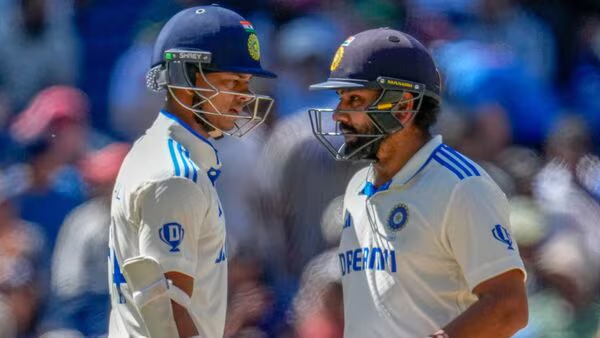
The ongoing India vs Australia series took a dramatic turn during the 4th Test at the Melbourne Cricket Ground (MCG), where a controversial Decision Review System (DRS) call involving Yashasvi Jaiswal sparked heated debate among cricket fans and former players. Jaiswal, who was batting on a well-composed 84, became the center of attention when he was controversially dismissed on the final day of the match. His dismissal marked a significant turning point in the game, and with it, India’s hopes of a series victory took a hit.
The Controversial Incident: DRS Call on Jaiswal’s Dismissal
Jaiswal, who had looked solid at the crease, attempted to pull a delivery from Australian pacer Pat Cummins, which appeared to be heading down the leg side. At first glance, it seemed Jaiswal had made no contact with the ball. However, the Australian team appealed, and on-field umpire Joel Wilson stood firm, not raising his finger. Unconvinced by the on-field call, Australian captain Cummins opted for a DRS review.
The third umpire, Sharfuddoula Saikat from Bangladesh, was called upon to make the final decision. The TV replays showed a faint deflection on the line of the ball as it passed Jaiswal’s bat. However, crucially, the snicko-meter did not show a significant spike, which made the dismissal questionable. Despite the lack of clear evidence, the third umpire ruled Jaiswal out, sending the young Indian opener back to the dressing room, visibly frustrated with the decision.
Rohit Sharma’s Disappointment with the Technology and Umpires’ Decision
Following the controversial dismissal, India’s captain Rohit Sharma did not hold back in his post-match comments. Expressing his confusion over the use of technology, he stated, “I don’t know what to make of that decision because the technology didn’t show anything but with the naked eye, it seemed that he did touch something. I don’t know how the umpires want to use the technology.”
Rohit’s frustration was palpable, as he admitted that although the technology did not provide clear evidence, the on-field visuals suggested there was a faint touch. He further emphasized that the technology used in cricket is not always foolproof, adding, “More often than not, we are the ones falling on the wrong side of it. I feel we have been a little unfortunate.”
Impact of the Dismissal on the Match and India’s World Test Championship Hopes
Jaiswal’s dismissal came at a crucial moment in the match, with India still in the hunt to chase down Australia’s target. His departure triggered a collapse in the Indian batting lineup, with India losing their last six wickets for just 55 runs. This led to a comprehensive 184-run victory for Australia, giving them a 2-1 lead in the series.
The loss was a huge setback for India’s hopes of making it to the World Test Championship (WTC) final. India now faces a must-win scenario in the fifth and final Test in Sydney, with hopes that Sri Lanka can defeat Australia 2-0 to open a pathway for India’s qualification.
DRS in Cricket: The Controversy Surrounding Technology
The Jaiswal incident is part of a larger ongoing debate in the cricketing world regarding the accuracy and fairness of the Decision Review System (DRS). While technology has significantly reduced umpire errors, it has not completely eliminated the controversies surrounding its implementation. The DRS system relies on technologies like Hawk-Eye, Ball Tracking, and Snicko-Meter, all of which are prone to certain degrees of error. In close calls, such as Jaiswal’s dismissal, the decision can often come down to the interpretation of the third umpire, further fueling the debate.
Despite the potential for human error, many players and fans believe that technology should provide clearer, more reliable decisions. However, as Rohit Sharma pointed out, the inconsistency of its application and the lack of concrete evidence often leave teams questioning whether the technology is being used correctly.
Conclusion: Was India Unlucky or Unjustly Treated?
Yashasvi Jaiswal’s controversial DRS dismissal has reignited the debate over the use of technology in cricket. While the snicko-meter showed no clear evidence of an edge, the faint deflection and the umpire’s eventual call led to widespread frustration among Indian fans. Rohit Sharma’s comments reflect the broader sentiment of the Indian team, who feel they have been at the receiving end of controversial DRS calls more often than not.
As the series moves towards its final match, the Indian team will look to put the controversy behind them and focus on securing a win in Sydney. For now, the cricketing world remains divided over whether the technology is helping or hindering the game’s fairness. Whatever the outcome, Jaiswal’s dismissal will certainly be remembered as one of the most debated moments in this series.