In a dramatic turn of events during the second Test between India and Australia in Adelaide, a contentious moment involving Mitchell Marsh has reignited the debate surrounding KL Rahul’s controversial dismissal in the first Test in Perth. The incident, which occurred during Australia’s first innings on Day 2 of the Adelaide Test, has led to widespread discussions on umpiring decisions, technology, and fairness in cricket.
The Incident That Sparked a Debate
During Australia’s first innings, Ravichandran Ashwin, India’s premier spinner, was bowling to Mitchell Marsh. The delivery saw Marsh coming forward to defend, and Ashwin immediately appealed for a leg-before-wicket (LBW) decision, believing the ball had struck Marsh’s pad before making contact with the bat. India’s captain, Rohit Sharma, consulted with Ashwin and subsequently opted for a Decision Review System (DRS) challenge.
Television replays showed that the ball had first struck Marsh’s pad before making contact with the inside edge of the bat. According to protocol, the third umpire, Richard Kettleborough, should have used all available technologies, including ball-tracking, to assess the situation thoroughly. However, the third umpire, after reviewing the Snicko (a device that detects sound spikes), concluded that there was not enough conclusive evidence to overturn the on-field decision. Surprisingly, Kettleborough did not even proceed with ball tracking, and the on-field umpire, Richard Illingworth, was advised to stick with his original call of ‘not out.’
Virat Kohli’s Strong Reaction
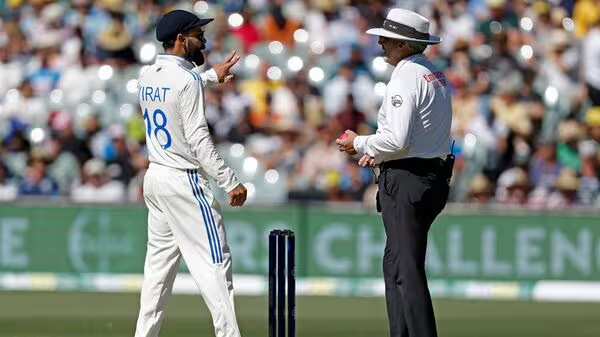
This controversial decision did not sit well with the Indian players, particularly former captain Virat Kohli. Kohli, known for his fiery on-field persona, immediately approached Illingworth, pointing out that Marsh’s situation was eerily similar to KL Rahul’s dismissal in Perth. “KL’s was the same in Perth, two spikes. One was bat and one was pad,” Kohli remarked, referencing the controversial dismissal of KL Rahul in the first Test.
Despite Kohli’s protests, Illingworth remained unmoved, and Kohli left the scene with a blank expression, clearly frustrated by the lack of consistency in umpiring decisions. The incident added fuel to the already simmering controversy regarding Rahul’s LBW dismissal in Perth, where similar technology, namely Snicko, played a central role in the decision-making process.
The KL Rahul Dismissal Controversy in Perth
KL Rahul’s dismissal in the first Test in Perth also sparked outrage and confusion among fans and experts alike. During his first innings, Rahul defended a delivery from Mitchell Starc, and the ball narrowly missed the bat before going to wicketkeeper Alex Carey. The on-field umpire, Richard Kettleborough, rejected the initial appeal. However, after reviewing the footage and a Snicko spike was detected, the third umpire, Kumar Dharmasena, overturned the decision, ruling Rahul out.
Despite the apparent spike on Snicko, the front-on camera angle could not conclusively confirm the ball’s contact with the bat, leaving fans divided. The third umpire used the spike as sufficient evidence to make the decision, leading to intense debate over the consistency of technology-based decisions.
What’s at Stake?
Both these decisions have brought up critical questions regarding the use of DRS and the role of technology in making fair and accurate decisions in modern cricket. In the case of Mitchell Marsh, many were puzzled as to why ball tracking, which could have confirmed whether the ball was hitting the stumps, was not used. Similarly, the inconsistency between Marsh’s dismissal and Rahul’s earlier one has led to calls for a review of the DRS protocol.
The use of Snicko, ball tracking, and other technological tools is central to making the right decisions in the modern era of cricket. However, instances like these underscore the limitations of the current system, particularly when crucial calls, like LBWs, are left to subjective interpretations. For Kohli and the Indian team, this controversy highlights the need for more consistent and transparent use of technology in cricket.
The Role of Umpires and Technology in Modern Cricket
While DRS was introduced to ensure fairness in decision-making, incidents like these expose the challenges associated with its use. Umpires rely heavily on technology to make crucial decisions, but its effectiveness can be questioned when inconsistencies arise. In this instance, many cricket experts and commentators questioned why ball tracking wasn’t even considered when assessing Marsh’s dismissal, particularly after the Snicko appeared to show a clear spike.
Furthermore, Kohli’s frustration with the decision reflects a deeper sentiment among players about the fairness of umpiring decisions in high-stakes matches. As the debate rages on, it is clear that technology has revolutionized cricket, but its application must be consistent to ensure that the right decisions are made.
Conclusion: The Need for Consistency in Umpiring Decisions
As the second Test progresses, the controversy surrounding Marsh’s LBW decision and Rahul’s Perth dismissal continues to dominate discussions in the cricket world. While technology such as DRS has undoubtedly improved the accuracy of umpiring decisions, moments like these remind us that there is still room for improvement in how it is applied. The inconsistency between the two decisions highlights the importance of refining the system and ensuring that all technologies, such as ball tracking, are used to their full potential.
As players and fans continue to voice their concerns, it is likely that the debate over the fairness of DRS and its impact on the game will remain a hot topic, not only in this series but in future cricket encounters around the world.