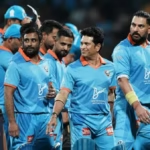
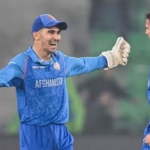
The ongoing debate about Indian captain Rohit Sharma’s availability for the 2024 Border-Gavaskar Trophy took an interesting turn when Australian cricketer Travis Head expressed his full support for Rohit’s decision to delay his travel to Australia. Rohit made headlines earlier this year when he chose to stay in India for the birth of his second child, a move that has sparked mixed reactions within the cricketing world. However, Head’s endorsement sheds light on the broader issue of balancing family commitments with professional duties in the demanding world of international cricket.
Travis Head Weighs In: “I Would’ve Done the Same Thing”
Travis Head, who has always been open about the sacrifices cricketers make in the name of their profession, shared his thoughts on the matter. The Australian batter, who faced a similar situation during the Pakistan series when his wife was expecting their second child, said, “I 100 percent support his decision. I would do the same thing in the same situation.”
Head’s comments underscore the emotional and personal sacrifices athletes often face, even at the highest level of international competition. While cricket offers fame and fortune, it also comes with challenges, including time away from family. In Head’s view, these personal moments are invaluable, and he believes Rohit made the right choice by prioritizing family over cricket.
“We sacrifice a lot of things as cricketers. We do live a very privileged life, but we miss some important milestones,” Head continued. “I would’ve done the same thing if I was in that position. He has made the right call.”
The Rohit Sharma Debate: Family vs. Cricket
Rohit Sharma’s decision has been met with varying opinions, both within India and abroad. The Indian cricket captain, known for his composed leadership and stellar batting, had chosen to stay in India when his wife, Ritika Sajdeh, was expecting their second child. The couple welcomed a baby boy just a week ago, which further amplified discussions on the topic.
Former cricketers have weighed in on Rohit’s absence from the first Test of the Border-Gavaskar Trophy. Indian legend Sunil Gavaskar, for instance, suggested that if Rohit was unavailable for the early matches of the series, Jasprit Bumrah could take over the captaincy duties for the remainder of the tournament.
However, this suggestion did not sit well with some former cricketers. Aaron Finch, former Australian captain, voiced his disagreement with Gavaskar’s comments, stating, “I disagree with Sunny on that totally. Rohit Sharma is the captain of the Indian cricket team. If you need to stay at home because your wife is having a baby… that’s such a beautiful moment. Take all the time that you need in that regard.” Finch’s statement reinforces the idea that personal milestones, such as the birth of a child, are irreplaceable and deserve respect.
Harbhajan Singh’s Perspective: Can Bumrah Lead India?
While Finch supported Rohit Sharma’s decision wholeheartedly, former Indian cricketer Harbhajan Singh raised an interesting point about the leadership aspect. Harbhajan acknowledged that while Rohit’s absence would be felt, it might not be a bad idea to have Jasprit Bumrah take charge of the Indian team temporarily, citing Bumrah’s leadership abilities.
“There shouldn’t be any problem as well because Bumrah has the ability to lead a team,” Harbhajan said, highlighting the depth of leadership options available in the Indian squad. This sentiment suggests that cricket, at the elite level, has many leaders who can step up when the need arises, offering flexibility in team management.
Will Rohit Sharma Play in the Perth Test?
As of now, there remains uncertainty about Rohit Sharma’s participation in the Perth Test, which is scheduled to begin shortly. According to reports, the Indian captain might miss the opening Test, with Jasprit Bumrah likely to step into the role of captain in his absence. Rohit is expected to rejoin the Indian squad ahead of the Adelaide Test on November 30, after spending some quality time with his family.
Additionally, reports suggest that Rohit could participate in a two-day warm-up match before the Adelaide Test, allowing him to get back into form ahead of the next fixture. His availability for the Perth Test is still unclear, and Indian fans will have to wait for official updates from the team management.
The Bigger Picture: The Intersection of Family, Cricket, and Personal Choices
The debate surrounding Rohit Sharma’s decision to stay with his family highlights a broader conversation about the balance between personal life and professional commitments, especially for athletes. It is an ongoing challenge for cricketers, who spend long stretches of time away from their families due to international schedules. While professional duty often calls, personal milestones like the birth of a child are moments that, once missed, cannot be recaptured.
Travis Head’s support for Rohit Sharma sends a strong message to fans and fellow players alike—family comes first. This perspective not only shows empathy but also reflects a growing understanding within the cricketing community about the importance of mental well-being and personal time. As the world continues to change, it is likely that more athletes will follow this example of prioritizing family without facing judgment for doing so.
Conclusion: Respecting Personal Choices in a High-Pressure World
As the 2024 Border-Gavaskar Trophy unfolds, all eyes will be on whether Rohit Sharma returns to the squad in time for the Perth Test or if Jasprit Bumrah will continue to lead the Indian side. However, regardless of the outcome, the cricketing world has learned an important lesson: family and personal well-being should be respected, even in the high-pressure environment of international cricket.
The support from players like Travis Head and Aaron Finch reinforces that cricket, like any other profession, is about balance—between personal joy and professional success. As more cricketers take similar decisions, we can hope to see a future where athletes are valued not just for their performances on the field but for their ability to prioritize what truly matters in life.