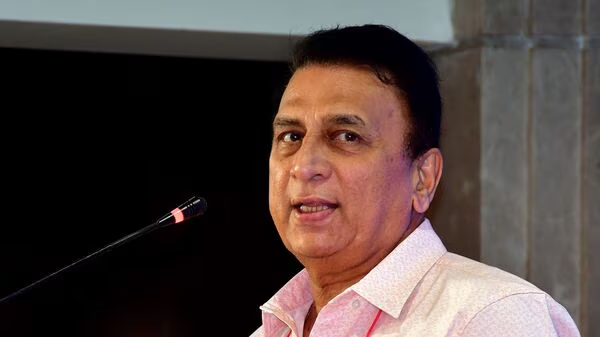
In a fierce critique, former Indian cricketer Sunil Gavaskar has slammed India’s team management, particularly captain Suryakumar Yadav and head coach Gautam Gambhir, over the controversial concussion substitute decision during the fourth T20I against England in Pune. Gavaskar’s remarks come after the incident, which has raised eyebrows in the cricketing world, with questions about the legitimacy of the substitute used.
Concussion Substitute Controversy: What Happened?
During India’s innings in the 4th T20I, Shivam Dube was struck on the helmet by a delivery. However, he continued batting until the end of India’s innings, which raised doubts about the nature and severity of his injury. Despite this, the Indian team management invoked the concussion substitute rule, requesting Harshit Rana, a fast bowler, to replace Dube. This substitution was approved by the match referee and umpires.
The issue escalated when England’s captain, Jos Buttler, and several former cricketers voiced their displeasure, claiming the replacement was not “like-for-like.” Buttler pointed out that Dube, a batting all-rounder, was replaced by Rana, a fast bowler, which they felt did not meet the requirements of the concussion substitute rule.
Gavaskar’s Strong Reactions
In his column for the Telegraph, Gavaskar criticized both the team management and the decision itself. He suggested that Dube, who had continued batting after the helmet blow, was not actually concussed. According to Gavaskar, there was no medical justification for the substitution, as Dube had shown no signs of serious injury. He further pointed out that the concussion substitute rule should only apply when a player is genuinely unable to continue due to head injury or concussion symptoms.
Gavaskar wrote, “In the Pune game, Dube batted right till the end after having got hit on the helmet earlier, so clearly, he was not concussed. So, allowing a concussion substitute itself was not correct.” He also emphasized that even if Dube had suffered a muscle strain, the substitution would have been limited to fielding only, not to replace him with a bowler like Harshit Rana.
He also expressed his opinion on the so-called “like-for-like” replacement, saying, “Even by the most generous stretching of the ‘like-for-like’ term, there was nothing such between Dube and Rana.” He humorously added, “They are the same height and have the same standard in fielding, but otherwise, there’s no comparison in their skill set.”
Gavaskar was critical of the fact that such a controversy had tarnished what was otherwise a remarkable win for India. “This Indian team is a superb team and doesn’t need its wins to get tarnished by such acts,” he concluded.
The Fallout: England’s Displeasure
England’s Jos Buttler did not hold back in expressing his frustration over the decision. “It is not a like-for-like replacement. We don’t agree with that,” Buttler said after the match. He sarcastically remarked, “Either Shivam Dube has put on about 25mph with the ball, or Harshit has really improved his batting.”
Buttler’s comments reflect the concern that the concussion substitute rule was being exploited, undermining the fairness of the game. Many former cricketers, including England’s experts, agreed that the substitution did not meet the spirit of the rule, which is intended to protect players from head injuries, not provide tactical advantages.
Understanding the Concussion Substitute Rule
The concussion substitute rule in cricket allows a team to replace a player who has suffered a concussion with a player of similar ability in the same role. The intention behind this rule is to ensure that a team isn’t penalized if one of their players cannot continue due to a concussion. However, the rule only applies when a player is genuinely concussed, and the replacement should be “like-for-like,” meaning the substitute should fulfill the same role on the field, whether as a batter, bowler, or all-rounder.
In the case of Dube’s injury, since he continued batting after being struck on the head, many believe that the concussion substitute rule was misused. The decision to replace a batting all-rounder with a bowler raised significant concerns about the fairness and integrity of the game.
Conclusion: Was the Concussion Substitute Rule Misused?
While India’s victory against England in the 4th T20I was convincing, the controversy surrounding the concussion substitute has overshadowed the result. Sunil Gavaskar’s criticism of the Indian team management, particularly Suryakumar Yadav and Gautam Gambhir, highlights the need for greater clarity in how the concussion substitute rule is applied.
As the cricketing world continues to debate the issue, it is clear that this incident has sparked a conversation about ensuring fairness in the game and maintaining the integrity of cricket’s laws. The question remains: was this a genuine case of a concussion substitute, or was it a tactical move that undermined the spirit of the game?
In the end, as Gavaskar rightly pointed out, India is a formidable team and does not need to rely on controversial decisions to secure its victories.