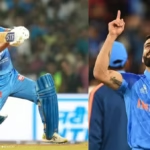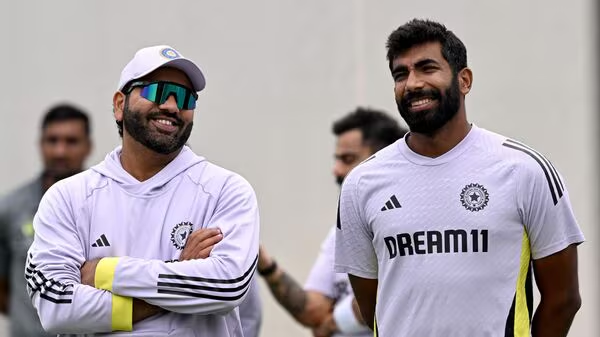
In an unexpected turn of events, Indian cricket captain Rohit Sharma made the surprising decision to opt out of the fifth and final Test against Australia at the Sydney Cricket Ground. This marked a significant moment in Indian cricket history, as Rohit Sharma became the first Indian captain to voluntarily drop himself from a Test match in the middle of an ongoing international series.
While the decision raised eyebrows, Jasprit Bumrah, who stepped in as captain for this match, emphasized that the decision was made with the team’s best interests in mind. Rohit’s absence from the playing XI was confirmed by Bumrah during the toss, stating that the veteran batsman had chosen to rest for the final match of the series.
Has an Indian Captain Ever Been Dropped Before?
Although it was unprecedented for Rohit Sharma to opt out in the middle of a series, he is not the first Indian captain to be dropped from the national team. The history of Indian cricket has seen other instances where a captain was dropped due to various reasons.
The first recorded instance of an Indian captain being dropped occurred during the 1958-59 series against the West Indies, when Polly Umrigar was dropped after a series of underwhelming performances. Another notable instance came in the early 2000s when Sourav Ganguly was dropped from the Indian team after a series of disappointing scores, coupled with a strained relationship with then-coach Greg Chappell.
Though Rohit Sharma’s decision to opt out is surprising, it is important to note that it was driven by a team-first mentality rather than any personal conflict, unlike the cases of Ganguly and Umrigar. In fact, there have been no public reports of friction between Rohit and the Indian team management, making this decision particularly intriguing.
Rohit Sharma’s Recent Form Struggles
Rohit Sharma, known for his calm demeanor and leadership skills, has been struggling with his batting form in recent months. Since the Bangladesh series, the 37-year-old opener has scored only 164 runs in 8 Test matches, averaging a mere 10.9 runs per match. This stark dip in performance may have played a role in his decision to step aside from the Test match, potentially to make way for younger players or allow himself time to regain form.
Interestingly, Rohit’s absence was not limited to just the Sydney Test; he had also missed the opening match of the Border-Gavaskar Trophy (BGT) in Perth earlier in the year. Despite these challenges, his leadership qualities continue to be appreciated by both fans and teammates alike.
Bumrah’s Take on Rohit’s Decision
At the Sydney Test, Bumrah, who took over as captain, spoke highly of Rohit Sharma’s leadership. During the toss, Bumrah expressed that Rohit’s decision to rest was a selfless one, showcasing the unity and collective spirit of the team. He praised Rohit’s leadership qualities, adding that the choice was made with the team’s success in mind, rather than personal preference.
Bumrah remarked, “Our captain has shown leadership by opting to rest in this game. That shows there’s a lot of unity in this team. There’s no selfishness. Whatever is in the team’s best interest, we are looking to do that.” This statement reflects the camaraderie within the Indian team, emphasizing that every decision made is for the collective good.
The Road Ahead for Rohit Sharma and Indian Cricket
Rohit Sharma’s decision to step down for the Sydney Test may raise questions about his future as a Test player and captain. However, it’s crucial to acknowledge that his leadership abilities and contributions to Indian cricket remain significant. His presence in the dressing room continues to inspire his teammates, and his experience remains invaluable to the team.
While Rohit may have struggled with form recently, it is not uncommon for even the most accomplished players to go through lean patches. His decision to rest, though surprising, may allow him to recharge and focus on regaining his form for future series.
In conclusion, while Rohit Sharma’s decision to opt out of the Sydney Test was historic, it was driven by a selfless mindset for the betterment of the Indian team. His leadership will continue to play a pivotal role in Indian cricket, as the team moves forward with fresh goals and challenges. Only time will tell if this moment becomes a turning point for both him and the Indian cricket team in the long run.