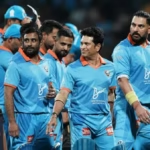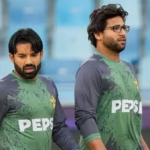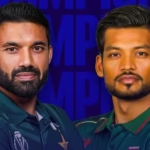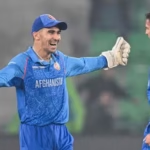
The 2025 ICC Champions Trophy, originally scheduled to be hosted in Pakistan, has become a hotbed for controversy, particularly with India’s reluctance to participate on Pakistani soil. Former Pakistan cricketer Kamran Akmal recently expressed his frustration, calling out the Board of Control for Cricket in India (BCCI) for what he described as “double standards.” This drama has only intensified as the tournament’s schedule remains in limbo, and the “hybrid model” is being considered as a potential solution.
The Hybrid Model Debate: A Compromise or a Setback?
The ICC Champions Trophy 2025 was initially slated to take place in Pakistan, but with the ongoing political tensions between India and Pakistan, the situation has become increasingly complicated. As it stands, the BCCI has firmly stated that it will not send its team to Pakistan due to security concerns and political issues. In response, the International Cricket Council (ICC) is reportedly considering a ‘hybrid model,’ where India would play all its matches in Dubai, while other teams would compete in Pakistan.
This has led to significant opposition from the Pakistan Cricket Board (PCB), which has voiced its objections. The PCB has threatened to boycott the tournament unless the hybrid model is applied universally for ICC events hosted in India up until 2031, creating an impasse in the process.
Kamran Akmal’s Stance: ‘Double Standards’ from BCCI
Kamran Akmal, who has represented Pakistan in over 250 international matches, has been vocal about his dissatisfaction with the current scenario. He pointed out that despite the political and security concerns that have prevented Indian teams from playing in Pakistan, India has still hosted Pakistan in the past for major tournaments like the 2016 World T20 and the 2023 ICC World Cup.
Akmal emphasized that Pakistan has made multiple tours to India despite challenges. He referenced the 2016 World Cup, when a match initially scheduled in Dharamshala was shifted to Kolkata, and Pakistan played in Ahmedabad for last year’s World Cup, despite reservations. For Akmal, this inconsistency reflects a “double standard” by the BCCI.
“It is disappointing to see such a scenario, but enough is enough. On one hand, India does not want to play in Pakistan for political reasons, but on the other hand, they play us in their country. This is clearly double standard,” Akmal told Telecom Asia Sport. He urged the PCB to stand firm on its position and protect Pakistan’s image in the international cricketing community.
Long-Term Solutions: Kamran Akmal’s Proposal for ICC
While Akmal expressed frustration, he also called for a long-term solution to the ongoing issue of Indo-Pakistani cricket relations. The 41-year-old suggested that if the hybrid model is adopted for the 2025 Champions Trophy, it should be extended to all future ICC events held in India. According to Akmal, this would ensure fairness and prevent Pakistan from being placed at a disadvantage due to political tensions.
Akmal went further, proposing that no India-Pakistan matches should take place in ICC tournaments unless both countries engage in bilateral series first. This, he believes, would reduce the risk of diplomatic issues impacting the sport and provide a clear pathway for resolving the ongoing tensions between the two nations.
“I think the ICC has to make a decision soon. If the hybrid model works for the 2025 Champions Trophy, it should be applied to every ICC event in India. No Indo-Pak matches should take place unless there is a bilateral series between the two countries,” Akmal added.
The Ongoing Tensions: The India-Pakistan Rivalry
The cricketing rivalry between India and Pakistan has long transcended the boundaries of sport, with political tensions often affecting their on-field engagements. The 2023 ICC World Cup was the latest chapter in this saga, with Pakistan’s team refusing to travel to India for the tournament, citing security concerns. India, in turn, has steadfastly maintained its stance on not traveling to Pakistan for events like the Asia Cup and the 2025 Champions Trophy.
Despite this, both nations continue to meet in ICC tournaments, albeit with increasing difficulty. Matches between India and Pakistan remain among the most-watched and high-stakes encounters in international cricket, yet the future of these fixtures is uncertain as political obstacles grow.
The ICC’s Role: Finding a Middle Ground
The ICC finds itself in the unenviable position of attempting to balance the needs and concerns of all its member nations. As a global cricket governing body, it is tasked with facilitating international competition while respecting the political landscapes of different regions. The hybrid model, though a potential compromise, raises questions about the long-term viability of such arrangements in future tournaments.
For the ICC, this issue goes beyond cricketing interests. The politics of India and Pakistan, with their deeply rooted and complex history, make every ICC decision regarding these two teams a highly sensitive matter. The ICC must tread carefully to ensure that it does not alienate either party while upholding the integrity of its tournaments.
Conclusion: A Crucial Crossroads for Cricket Diplomacy
The ongoing dispute over the 2025 ICC Champions Trophy illustrates a broader issue of cricket diplomacy. Kamran Akmal’s calls for a fair and consistent policy are backed by a desire to ensure that both India and Pakistan have equal opportunities in future ICC events. The adoption of a hybrid model may offer a temporary solution, but it remains to be seen whether this can lead to a permanent resolution of the issue.
For cricket fans around the world, the hope is that a compromise can be reached that allows both nations to take part in the global cricketing community without further escalation of political tensions. Until then, the saga of the India-Pakistan cricket rivalry will continue to captivate and divide audiences globally.